Screenless wearables are the fastest-growing corner of fitness tracking. No display, no notifications, no wrist that lights up at dinner. Just a sensor that sits on your wrist, arm or finger and reports what your body did. WHOOP made the format famous. In 2025 and 2026 Polar, Garmin, Amazfit and Google all shipped their own, and the smart rings from Oura and Ultrahuman compete for the same buyer.
This guide scores the seven worth buying today on eight dimensions, puts them into tiers, and shows the facts behind each score. It is written for someone who has narrowed the choice to "no screen" and wants to know which one, and why.
How we scored
Each device gets a score from 1 to 10 on eight dimensions: sleep tracking, recovery and HRV, activity tracking, battery and comfort, sensor technology, extra features, data openness, and value over three years. The scores come from published validation studies (with the hardware generation each study tested), vendor specifications, and the consensus of established reviewers. We did not test the devices by hand. No vendor paid for, saw or reviewed this ranking.
The tier is an editorial verdict that the scores inform, not a weighted sum. The scores are published so you can see the reasoning and disagree with it.
The scores
| Dimension | WHOOP 5.0 | Garmin CIRQA | Oura Ring 5 | Polar Loop | Google Fitbit Air | Ultrahuman Ring PRO | Amazfit Helio Strap |
|---|---|---|---|---|---|---|---|
| Sleep tracking | 8 | 7 | 9 | 6 | 7 | 6 | 6 |
| Recovery and HRV | 9 | 8 | 8 | 7 | 7 | 6 | 6 |
| Activity tracking | 7 | 9 | 5 | 6 | 6 | 4 | 7 |
| Battery and comfort | 9 | 8 | 7 | 7 | 7 | 9 | 8 |
| Sensor technology | 9 | 7 | 8 | 4 | 7 | 7 | 6 |
| Extra features | 8 | 6 | 8 | 3 | 7 | 6 | 5 |
| Data openness | 7 | 6 | 5 | 9 | 5 | 8 | 5 |
| Value (3 years) | 4 | 8 | 4 | 8 | 9 | 6 | 9 |
The tiers
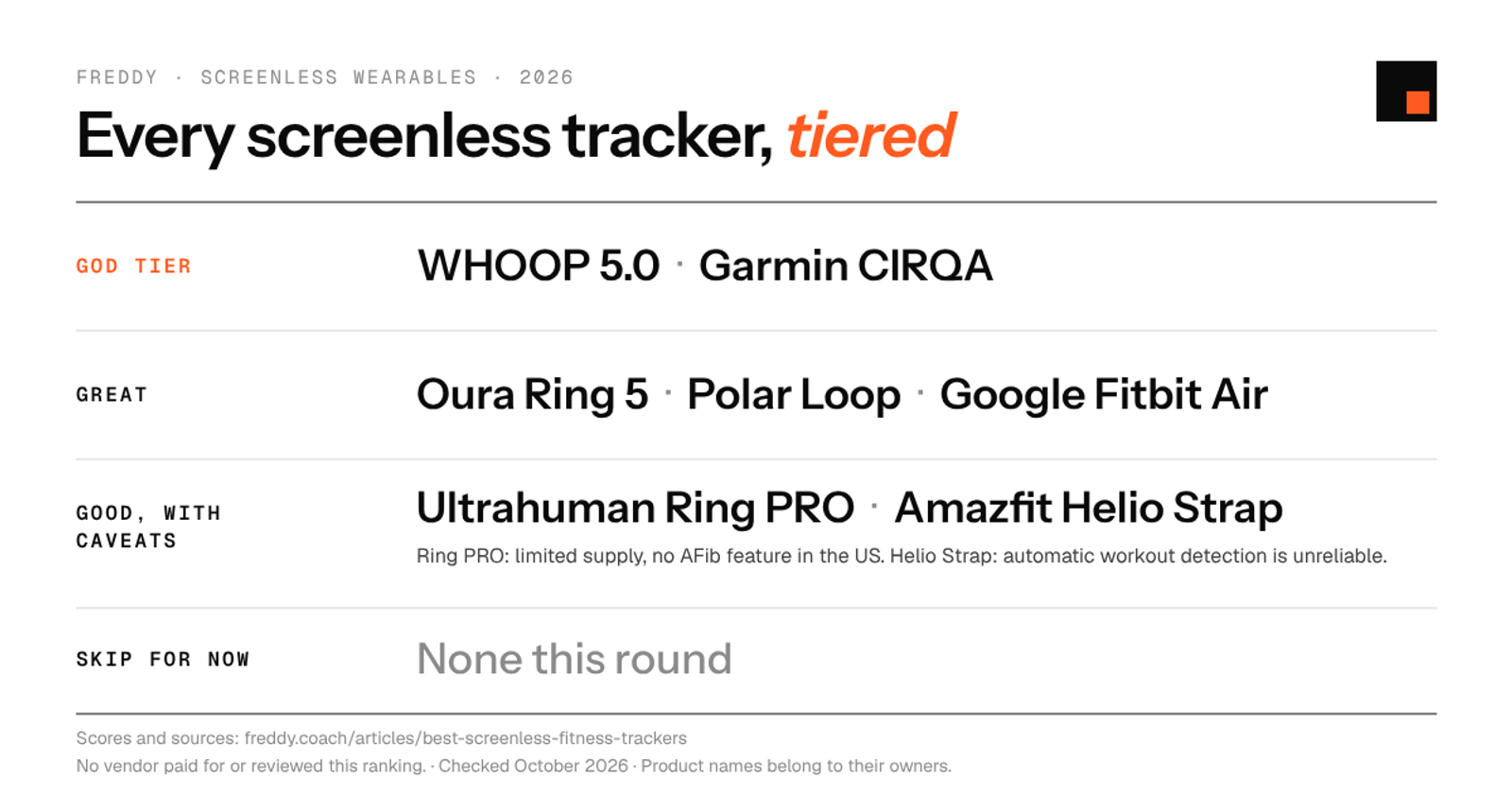
God tier
- WHOOP 5.0. The most complete recovery system in the category, two weeks per charge, and a band you charge while you wear it. The catch is the price: you pay every year, forever.
- Garmin CIRQA. Garmin's training science in a $199.99 band with no subscription. The best activity tracking here, and it broadcasts heart rate to your bike computer.
Great
- Oura Ring 5. The best-studied sleep tracker you can buy, now in a much smaller ring. The membership is needed for full insights and for any third-party access to your data.
- Polar Loop. The most open data story in this list, no subscription, and Polar's long-trusted Nightly Recharge. The sensor set is the thinnest here.
- Google Fitbit Air. $99.99, 12 grams, AFib alerts and a free core feature set. The cheapest way into this category that does not feel cheap.
Good, with caveats
- Ultrahuman Ring PRO. Fifteen days per charge and no subscription, but supply is limited and the US version has no AFib feature.
- Amazfit Helio Strap. Strong value and strength-training features at $99.99, but reviewers find its automatic workout detection unreliable.
Skip for now
- None this round. Every device in the list does its core job. The caveats above are the reasons a device sits lower, not reasons to avoid it.
Sleep tracking
Sleep is the main reason most people buy a screenless tracker, and it is the dimension with the most published evidence. That evidence is thinner than the marketing suggests: no independent study has yet tested the current generation of any device here.
| Device | Sleep stages | Automatic sleep detection |
|---|---|---|
| WHOOP 5.0 | Yes | Yes, with naps |
| Garmin CIRQA | Yes | Yes, with naps |
| Oura Ring 5 | Yes | Yes, naps of 15 minutes to 3 hours |
| Polar Loop | Yes | Yes; naps not documented |
| Google Fitbit Air | Yes | Yes; naps not documented |
| Ultrahuman Ring PRO | Yes | Yes, with naps |
| Amazfit Helio Strap | Yes | Yes, naps over 20 minutes |
Oura has the deepest research record. A 2024 study in Sleep Medicine found 79% agreement with polysomnography on four-stage classification across 96 participants (source). A 2025 study of a clinical sleep-lab population found 53% four-stage accuracy (source). Both tested the Gen3 ring, not the Ring 5.
WHOOP's main validation, Miller et al. 2020, found 89% agreement on sleep versus wake (source). A 2025 six-device study found it classified about 62% of REM correctly (source). Both tested WHOOP 4.0.
Garmin, Google and Polar have long sleep-tracking histories on their watches, but no independent study of these bands yet. Ultrahuman and Amazfit have no independent sleep-stage validation that we could find.
Recovery and HRV
Every device here measures heart rate variability with the same method, RMSSD. They differ in when they measure it and in what they build on top of it.
| Device | Documented HRV metric |
|---|---|
| WHOOP 5.0 | RMSSD |
| Garmin CIRQA | RMSSD |
| Oura Ring 5 | RMSSD |
| Polar Loop | RMSSD |
| Google Fitbit Air | RMSSD |
| Ultrahuman Ring PRO | RMSSD |
| Amazfit Helio Strap | RMSSD |
WHOOP measures HRV in the last slow-wave sleep period of the night and builds its daily Recovery score on it. Recovery is the product, and it shows. Garmin averages overnight RMSSD into HRV Status against your own three-week baseline, and feeds it into Training Readiness and Body Battery. Oura turns it into a Readiness score. Polar's Nightly Recharge combines HRV with sleep into one morning reading. Google reports nightly HRV from your longest sleep. Amazfit rolls it into its BioCharge score.
Ultrahuman changed its sleep algorithm in September 2026. Its own study of 1,026 members found the update lowered sleep HRV by 33.8% at the median (source). If you compare months of Ultrahuman data, expect a step in the line. The same is true of any device: HRV numbers from different brands are not comparable with each other, even when they use the same method.
Activity tracking
None of these devices has GPS. For a run with pace and distance, each one borrows your phone's GPS. The differences are in what they detect on their own.
| Device | Automatic activity detection | Strength rep counting | Built-in GPS | Heart-rate broadcast |
|---|---|---|---|---|
| WHOOP 5.0 | Yes, 45 types | No | No | Yes, Bluetooth |
| Garmin CIRQA | Yes | Yes | No | Yes, ANT+ and Bluetooth |
| Oura Ring 5 | Yes | No | No | No |
| Polar Loop | Yes | No | No | No |
| Google Fitbit Air | Yes | Not documented | No | Not documented |
| Ultrahuman Ring PRO | Partial: it detects, you confirm | No | No | No |
| Amazfit Helio Strap | Partial: reviewers call it unreliable | Yes, 25 movements | No | Yes, Bluetooth |
Garmin wins this dimension clearly. The CIRQA detects workouts on its own, counts strength reps, has more than 80 sport types and Garmin's full training-load metrics, and broadcasts heart rate over ANT+ and Bluetooth to a bike computer or a gym machine. Amazfit counts reps across 25 movements and has a HYROX race mode, but its automatic detection is the weak point. WHOOP detects 45 activity types and measures strain well, but it does not count reps. The rings are weaker here by design: a ring on your finger is a poor place to measure a barbell.
Battery and comfort
| Device | Battery (vendor claim) |
|---|---|
| WHOOP 5.0 | 14 days |
| Garmin CIRQA | 10 days |
| Oura Ring 5 | 6 to 9 days |
| Polar Loop | 8 days |
| Google Fitbit Air | 7 days |
| Ultrahuman Ring PRO | 15 days |
| Amazfit Helio Strap | 10 days |
WHOOP and Ultrahuman lead. WHOOP also lets you slide a battery pack onto the band and charge without taking it off, so in practice it never leaves your wrist. Garmin and Amazfit last about ten days. The Fitbit Air weighs 12 grams with the band, and a five-minute charge gives a day. The Oura Ring 5 is 40% smaller than the Ring 4, and that smaller body costs it some battery: Oura now says 6 to 9 days, depending on ring size.
Sensor technology
| Device | SpO2 | Skin temperature | ECG |
|---|---|---|---|
| WHOOP 5.0 | Yes | Yes | WHOOP MG only |
| Garmin CIRQA | Yes | Yes | No |
| Oura Ring 5 | Yes | Yes | No |
| Polar Loop | No | Partial: developer SDK only | No |
| Google Fitbit Air | Yes | Yes | No |
| Ultrahuman Ring PRO | Yes | Yes | No |
| Amazfit Helio Strap | Yes | Sensor listed; feature not documented | No |
WHOOP is the only device here with an ECG, and only on the WHOOP MG hardware in the top membership tier. Every other device covers SpO2 and skin temperature, except Polar, which has neither as a user feature. Oura claims its new sensor design gives about 12% more accurate overnight HRV than the Ring 4. That is a vendor claim, not yet independently tested.
Extra features
| Device | AFib notifications | Blood-pressure feature | Women's health |
|---|---|---|---|
| WHOOP 5.0 | WHOOP MG only | WHOOP MG: Blood Pressure Insights | Yes |
| Garmin CIRQA | No | No | Yes |
| Oura Ring 5 | No | Partial: Blood Pressure Signals, a wellness feature | Yes, with membership |
| Polar Loop | No | No | No built-in feature |
| Google Fitbit Air | Yes | No | Yes |
| Ultrahuman Ring PRO | No (US) | No | Yes, free |
| Amazfit Helio Strap | No | No | Not documented |
The Fitbit Air is the only band under $200 in this list with AFib notifications, and they are free. WHOOP MG adds AFib alerts, an ECG and blood-pressure insights, but only in the WHOOP Life tier. Oura's Blood Pressure Signals is a nighttime trend, not a cuff reading or a medical measurement. Ultrahuman's AFib feature exists outside the US but is not available to US buyers. Polar has no built-in cycle tracking, and Amazfit does not document one.
Data openness
This is the dimension other comparisons skip. If you want your data in another app, a spreadsheet or an AI assistant, it matters who can read it and on what terms.
| Device | Developer API | Apple Health | Health Connect |
|---|---|---|---|
| WHOOP 5.0 | Self-serve for 10 members; review above that | Yes | Yes |
| Garmin CIRQA | Application and approval | One-way, from Garmin Connect | One-way write |
| Oura Ring 5 | OAuth only; 10 users per app before approval; no data without a membership | Yes; HRV, temperature, SpO2 and resting HR are not written | Yes, including HRV |
| Polar Loop | Self-serve | Yes, through Polar Flow | Yes, through Polar Flow |
| Google Fitbit Air | Restricted scopes; verification and a yearly security assessment | Yes, two-way; no HRV | Yes |
| Ultrahuman Ring PRO | Self-serve personal token; apps through a portal | Yes | Yes |
| Amazfit Helio Strap | Partner-gated: enterprise verification | Yes, through the Zepp app | Yes, through the Zepp app |
Polar is the most open: a self-serve developer API, both phone health platforms, and no subscription in the way. Ultrahuman comes next, with a personal token any user can create and its own MCP server. WHOOP lets a small app start on its own and reviews anything larger. Garmin and Amazfit require a business application before an app can read your data.
Oura fell furthest this year. It ended personal access tokens, and a Gen3 or later ring returns no data through the API without an active membership (source). Google retired the Fitbit Web API in autumn 2026. Its successor, the Google Health API, puts health data behind restricted scopes, app verification and a yearly security assessment (source). freddy connects to it directly.
Value over three years
| Device | Hardware | Required subscription | Optional subscription | 3-year cost |
|---|---|---|---|---|
| WHOOP 5.0 | Included | $199 to $359/year | $597 to $1,077 | |
| Garmin CIRQA | $199.99 | None | Connect+ | $199.99 |
| Oura Ring 5 | $399 to $499 | $69.99/year | $608.97 to $708.97 | |
| Polar Loop | $199.99 | None | $199.99 | |
| Google Fitbit Air | $99.99 | None | Google Health Premium | $99.99 |
| Ultrahuman Ring PRO | $479 | None | Ultrahuman Max | $479 |
| Amazfit Helio Strap | $99.99 | None | Zepp Aura | $99.99 |
The WHOOP membership includes the hardware and comes in three tiers: One at $199/year, Peak at $239/year and Life at $359/year (source). Over three years it is the most expensive device here. Oura is close behind once the membership is added. Every other device is a one-time purchase, and each optional subscription adds coaching or AI features, not your core data.
Also considered
- Ultrahuman Ring AIR. Still sold outside the US. Ultrahuman does not ship it to US addresses.
- Samsung Galaxy Ring. Works with Android phones only.
- RingConn Gen 3. A budget ring with up to 14 days per charge and no subscription.
- Garmin Index Sleep Monitor. A screenless upper-arm band you wear only at night. The natural pick if you already wear a Garmin watch by day.
- Amazfit Helio Ring. Not on Amazfit's US store.
Which one to buy
- You train seriously and want one device for recovery and workouts: Garmin CIRQA. Pick WHOOP 5.0 instead if recovery coaching matters more to you than the subscription cost.
- You care most about sleep and hate wearing anything on your wrist: Oura Ring 5.
- You refuse to pay a subscription: Polar Loop, Garmin CIRQA or Amazfit Helio Strap.
- You want your data to stay easy to move: Polar Loop.
- You want the lowest price with AFib alerts: Google Fitbit Air.
- You hate charging: WHOOP 5.0 or Ultrahuman Ring PRO.
- You lift and want reps counted: Garmin CIRQA, or Amazfit Helio Strap on a budget.
Whichever one you choose, its data can do more than fill a chart in one app. freddy connects sources like Polar, Garmin and Oura to the AI assistant you already use, so you can ask about your sleep, training and recovery in plain words.
Pricing and feature details verified 2026-10-30. Check vendor sites for current details before committing.