Your Concept2 Logbook holds every row, ski, and bike session you have done on an erg, and the AI assistant you talk to every day cannot see any of it. The Model Context Protocol (MCP) is the open standard that connects the two, and eight options now do it for Concept2.
This list ranks them by setup effort, from least to most. freddy is ours, and it is first: nothing to install, no token to paste, and your erg sessions next to your sleep and recovery in any AI app that speaks MCP. Each entry says who it suits.
What to know first
The question that sorts Concept2 options is where they read from. A tool that reads the Logbook directly sees every result, hand-entered ones included. A tool that reads a copy in another training platform sees only what that platform imported.
The Logbook API is open to any Logbook user, free, with a sign-in for apps and a long-lived personal token for your own use, under Edit Profile, Applications (Concept2 API docs). The token opens your whole Logbook, so keep it in a config file on your own computer.
Where a server runs decides where you can use it. A hosted server is a web address, so it works in Claude and ChatGPT on the web, on the desktop, and on your phone. A server on your computer works only in desktop apps such as Claude Desktop and Cursor. The Claude phone app and claude.ai cannot reach it, and ChatGPT needs a tunnel you set up yourself.
The list
1. freddy
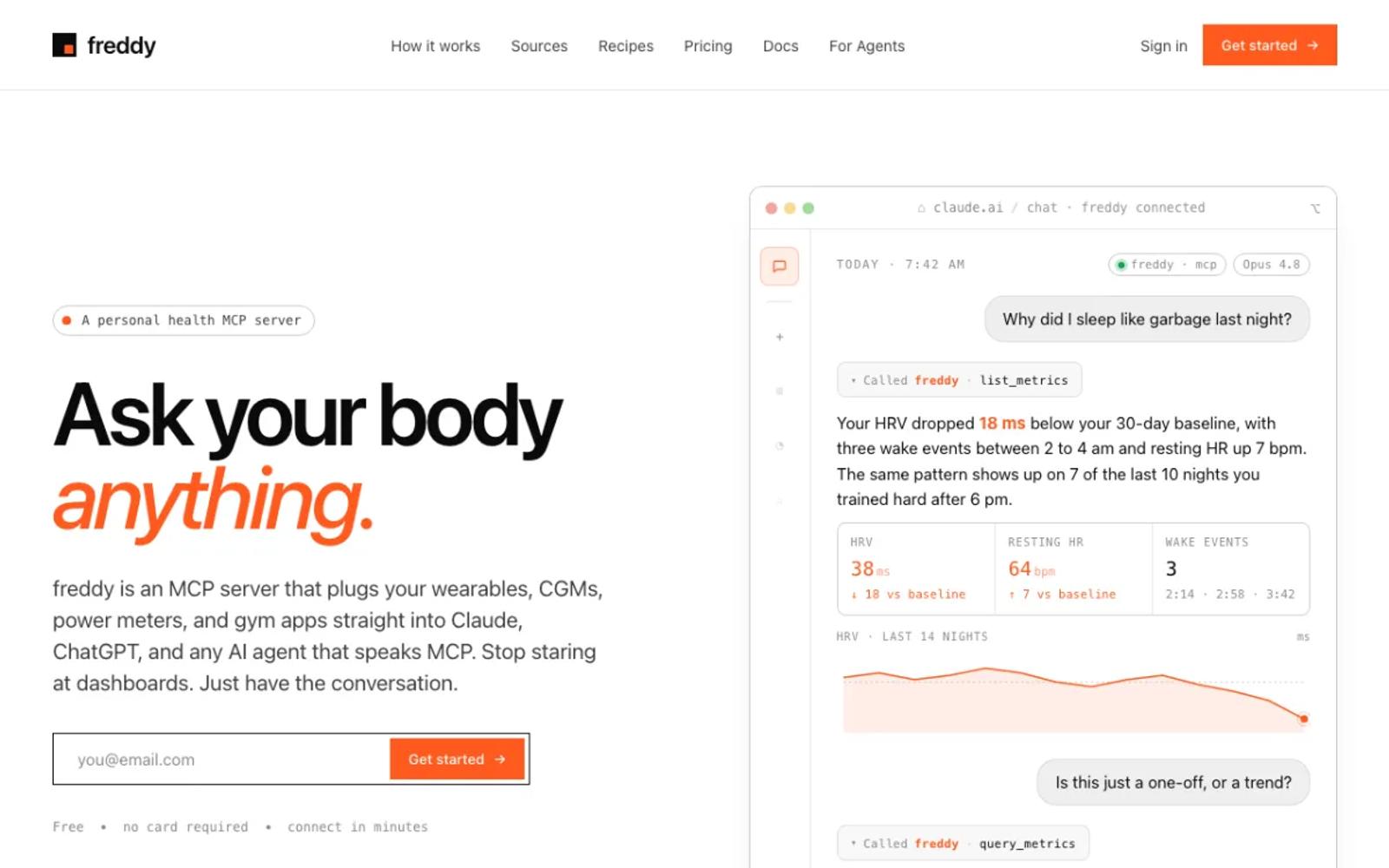
freddy is a hosted MCP server that brings your health data from all your apps into one place. You sign in with a code we email you, connect Concept2 on the Logbook's own sign-in screen, and add freddy to your AI app, from ChatGPT's app directory or with one personal URL in Claude, Cursor, or any other MCP client.
freddy reads your Logbook directly, read-only, so every result comes through, and new sessions arrive soon after you log them. The same account reads Garmin, Oura, Polar, Apple Health, and more, so a question like "do my 2k splits track my sleep" works across all of them.
Our Concept2 guide walks through every step.
Setup: three steps in your browser. Nothing to install, nothing to update, and it works on your phone too.
Price: free for one source with a short history window, or $49/year for all your sources and your full history.
Best for: almost everyone who rows, skis, or rides on a Concept2 erg.
2. AthleteData
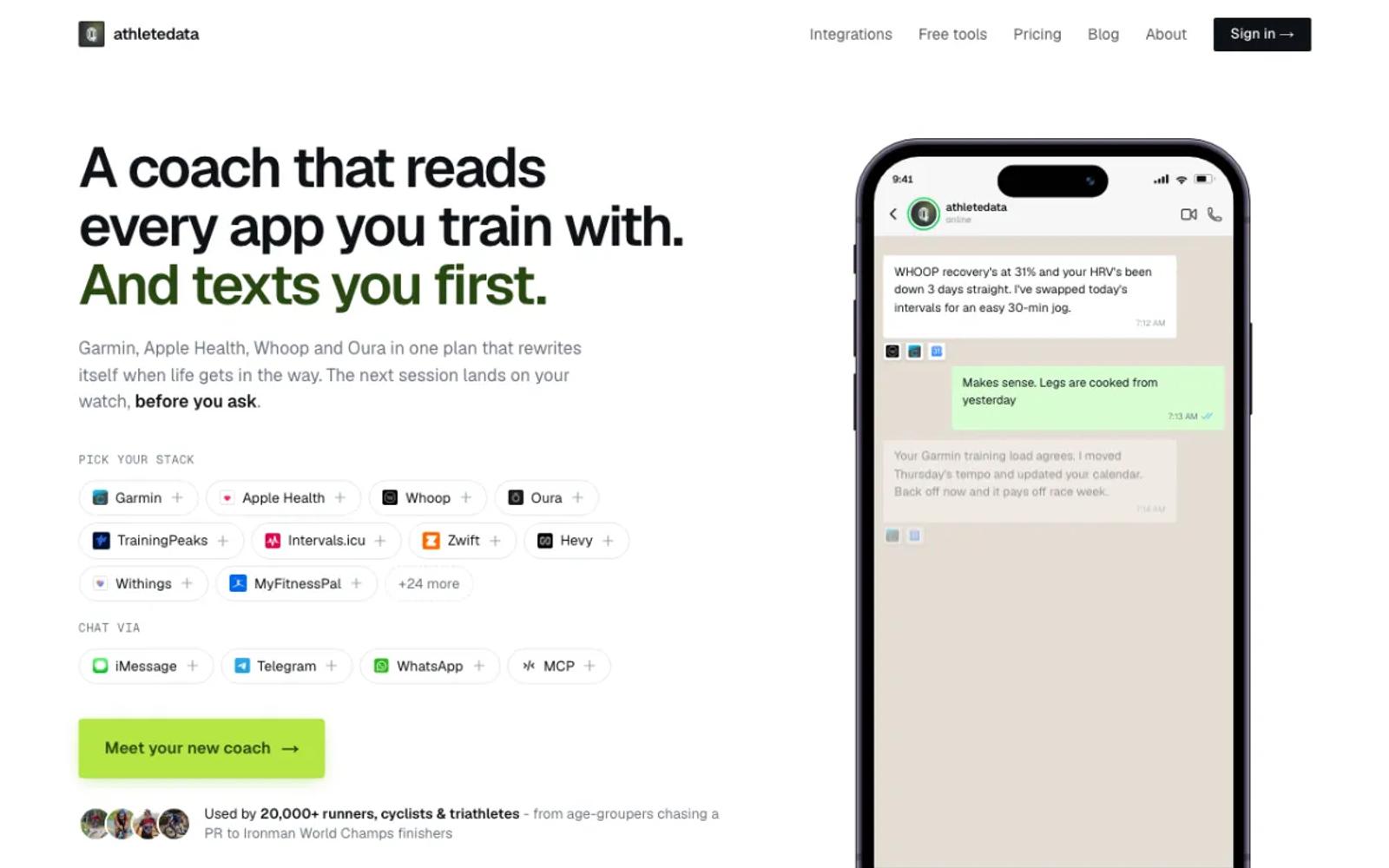
AthleteData is a hosted AI coach with a cheaper MCP-only plan. It signs in to your Logbook, reads it, and imports your history when you connect, next to more than 30 other apps. The coaching plan messages you after workouts; the MCP-only plan leaves that out.
Setup: start the trial, connect Concept2, and add the connector to your AI app.
Price: MCP-only is CHF 9 a month or CHF 69 a year, after a 7-day free trial (plans). Coaching is CHF 29.90 a month.
Best for: athletes who want a coach that gets in touch first, as well as answers.
3. Tredict
Tredict is an endurance training platform with its own MCP server. It imports up to 8 years of Concept2 sessions, but hand-entered Logbook results do not come across.
It works best if Tredict is already your training log, and its MCP server needs Tredict's paid access for detailed data.
Setup: create a Tredict account, connect Concept2, then add Tredict to your AI app.
Price: 2 months free, then $49 for 12 months, paid once (€49 in Europe; prices).
Best for: endurance athletes who already plan their training in Tredict.
4. IcuSync, through Intervals.icu
An indirect route. The Logbook syncs to Intervals.icu, which is free: the last 28 days first, then your full history on request. IcuSync serves Intervals.icu over MCP in Claude on the web, desktop, and phone, and in ChatGPT and Grok.
Setup: create an Intervals.icu account, link Concept2 there, sign up for IcuSync, and paste its URL into your AI app.
Price: Intervals.icu is free; IcuSync is $20 a year.
Best for: athletes who already train in Intervals.icu.
5. concept2-mcp
A small local server with 5 read tools, stroke data among them, MIT licensed. It runs with one npx command and your personal token.
It is a one-day project with no stars yet, so expect little maintenance.
Setup: moderate. Create your personal token in the Logbook, install Node, and add its npx command with the token to your AI app's config. Desktop apps only.
Price: free and open source.
Best for: rowers who want stroke-level detail on their own computer.
6. mcp-concept2-logbook
A local server with 10 tools, read-only by default, MIT licensed. It takes your personal token or your own Concept2 sign-in app, which renews itself.
Its README says a personal token expires after 7 days, while Concept2 calls it long-lived; the sign-in app avoids the question.
Setup: moderate. Create a token or register an app in the Logbook, install Node, and add its npx command to your AI app's config. Desktop apps only.
Price: free and open source.
Best for: people who want a broader local tool set.
7. ergmcp
A Python server with 6 tools, personal bests among them, MIT licensed. It runs with uv and your personal token.
Setup: moderate. Create your personal token, install uv, and add its command with the token to your AI app's config. Desktop apps only.
Price: free and open source.
Best for: Python users who want a small server with personal bests.
8. Intervals.icu with a local MCP server
The do-it-yourself version of the Intervals.icu route: the Logbook syncs to Intervals.icu, and hhopke/intervals-icu-mcp reads it from your own computer with 67 tools, MIT licensed. It sees what Intervals.icu imported.
Setup: moderate. Link Concept2 to Intervals.icu, install uv, copy your athlete ID and API key, and add one command to your AI app's config. Desktop apps only.
Price: free and open source.
Best for: people who already train in Intervals.icu and want a local server.
We left out two more local servers, because neither has a license file and one includes a tool that deletes a Logbook result for good.
| Tool | Setup | Reads from | Price |
|---|---|---|---|
| freddy | None; web, desktop, and phone | The Logbook, directly | Free tier; $49/year |
| AthleteData | Account; web, desktop, and phone | The Logbook, directly | CHF 69/yr or CHF 9/mo |
| Tredict | Tredict account; web, desktop, and phone | Tredict's import | 2 months free, then $49 per 12 months |
| IcuSync | Two accounts; web, desktop, and phone | Intervals.icu's import | $20/yr |
| concept2-mcp | Token and config file; desktop only | The Logbook, directly | Free |
| mcp-concept2-logbook | Token or app, and config file; desktop only | The Logbook, directly | Free |
| ergmcp | Token and config file; desktop only | The Logbook, directly | Free |
| hhopke/intervals-icu-mcp | Terminal and config file; desktop only | Intervals.icu's import | Free |
How to choose
For most people, the answer is freddy: every Logbook result, nothing to run, and your erg sessions next to your recovery data in any AI app that speaks MCP. The exceptions:
- You want a coach that gets in touch first: AthleteData.
- You already train in Intervals.icu: IcuSync.
- You want stroke-level detail on your own computer: concept2-mcp.
Prices and details verified in September 2026. This space moves fast, so check each vendor's site for current details before you commit. For other wearables, see our roundup of wearable MCP servers.