Your Fitbit holds years of your steps, sleep, and heart rate, and the AI assistant you talk to every day cannot see any of it. The Model Context Protocol (MCP) is the open standard that connects the two. For Fitbit there is a catch: Google turns off the Fitbit Web API that most Fitbit MCP servers were built on, on October 30, 2026.
This list covers only the options that still work after that. freddy is ours and sits first: no Google Cloud project, nothing to keep running, and it works in any AI app that speaks MCP. After it, the list runs from least setup effort to most. Each entry says who it suits.
What to know first
Google stops supporting the old Fitbit Web API on September 30, 2026, and turns it off on October 30, 2026 (Google Health API). Its replacement is the Google Health API, and the Fitbit app itself is now called Google Health. A Fitbit MCP server that asks you to register an app at dev.fitbit.com is built on the old API, so skip it: it stops working on October 30.
That leaves two ways in. The first is the Google Health API, which signs you in with your Google account. A hosted service handles that for you, while a server you run yourself needs its own Google Cloud project, which is real work. The second is your phone: the Google Health app can share your data into Health Connect on Android and Apple Health on iPhone, and other apps read it from there.
The phone route has gaps, because Google does not share every metric. On Android it leaves out blood oxygen (SpO2), and on iPhone it leaves out HRV and skin temperature (Android list, iPhone list).
One trap for every server you run yourself: while your Google Cloud app is in Testing, Google ends the sign-in after 7 days. Publish the app in the Google Cloud console, then sign in again.
Where a server runs decides where you can use it. A hosted server is a web address, so it works in Claude and ChatGPT on the web, on the desktop, and on your phone. A server on your computer works only in desktop apps such as Claude Desktop and Cursor. The Claude phone app and claude.ai cannot reach it, and ChatGPT needs a tunnel you set up yourself.
Claude and ChatGPT can also read phone health data without MCP. Claude's phone apps read Apple Health and Health Connect, in beta for Pro and Max plans in the US. ChatGPT Health reads Apple Health from an iPhone, in the US. Each works inside its own assistant only, and your Fitbit data reaches them only through the Google Health share. Outside the US, or in more than one AI app, you need one of the options below.
The list
1. freddy
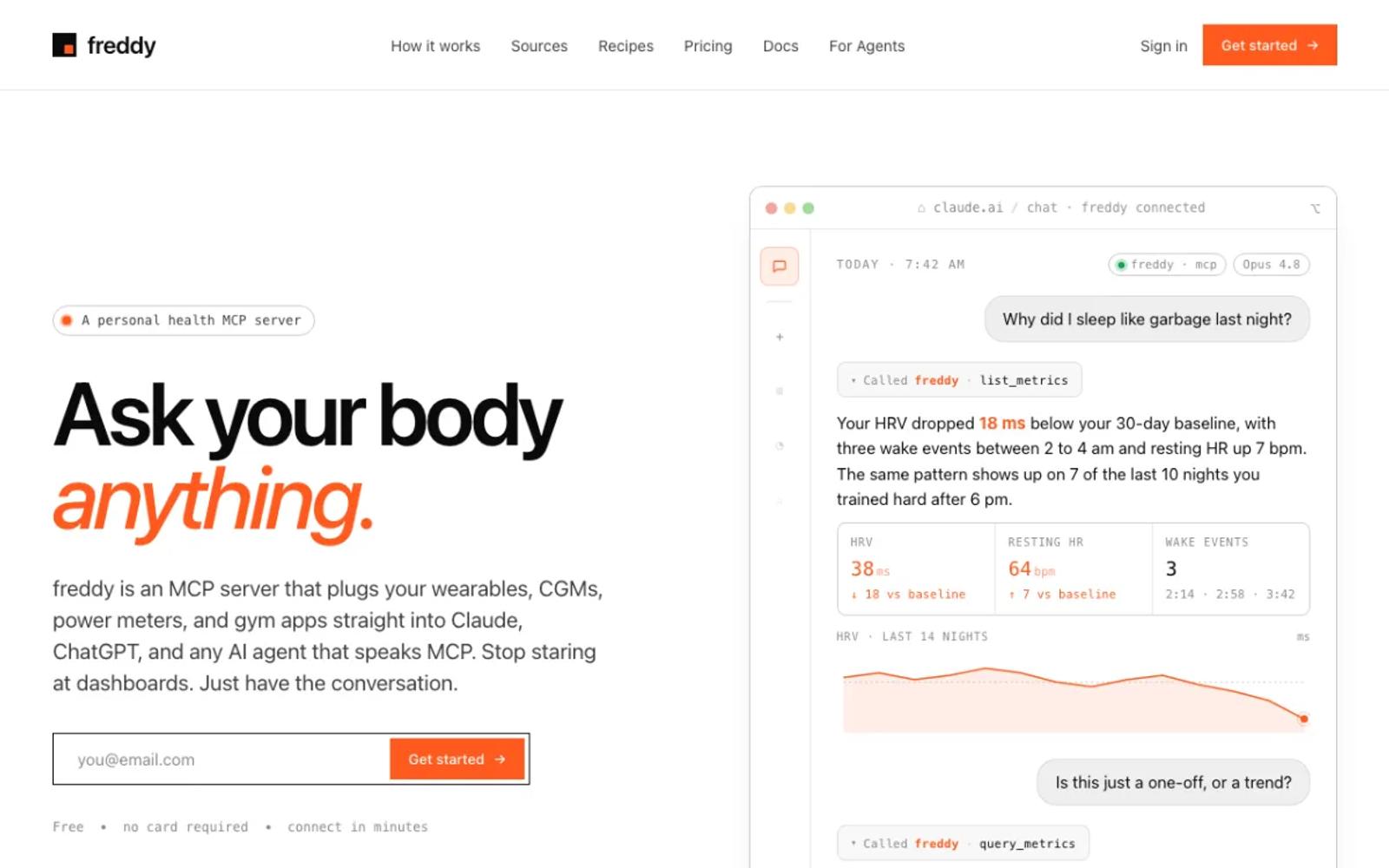
freddy is a hosted MCP server for your health data from all your apps. For Fitbit it uses the phone route: the Google Health app shares into Health Connect or Apple Health, and freddy's phone app reads it from there. In freddy, pick Fitbit, and it shows you where to turn on sharing in the Google Health app. Then add freddy to your AI app, from ChatGPT's app directory or with one personal URL in Claude, Cursor, or any other MCP client.
freddy never used the old Fitbit Web API, so the change does not touch it, and there is no Google Cloud project to set up. The same account reads Garmin, Oura, Polar, Withings, and more, so you can ask across all of them. Your phone sends new data in the background when the system allows it, and right away when you open freddy.
The limits come from the phone route: HRV reaches freddy only from Android, and blood oxygen only from iPhone. Our setup guide walks through every step.
Setup: install freddy on your phone, connect Apple Health or Health Connect, turn on Google Health's sharing, and add freddy to your AI app. No server and no developer account.
Price: free for one source with a short history window, or $49/year for all your sources and your full history.
Best for: most Fitbit users, and anyone who wants Fitbit next to their other apps in one place.
2. Wellness Project
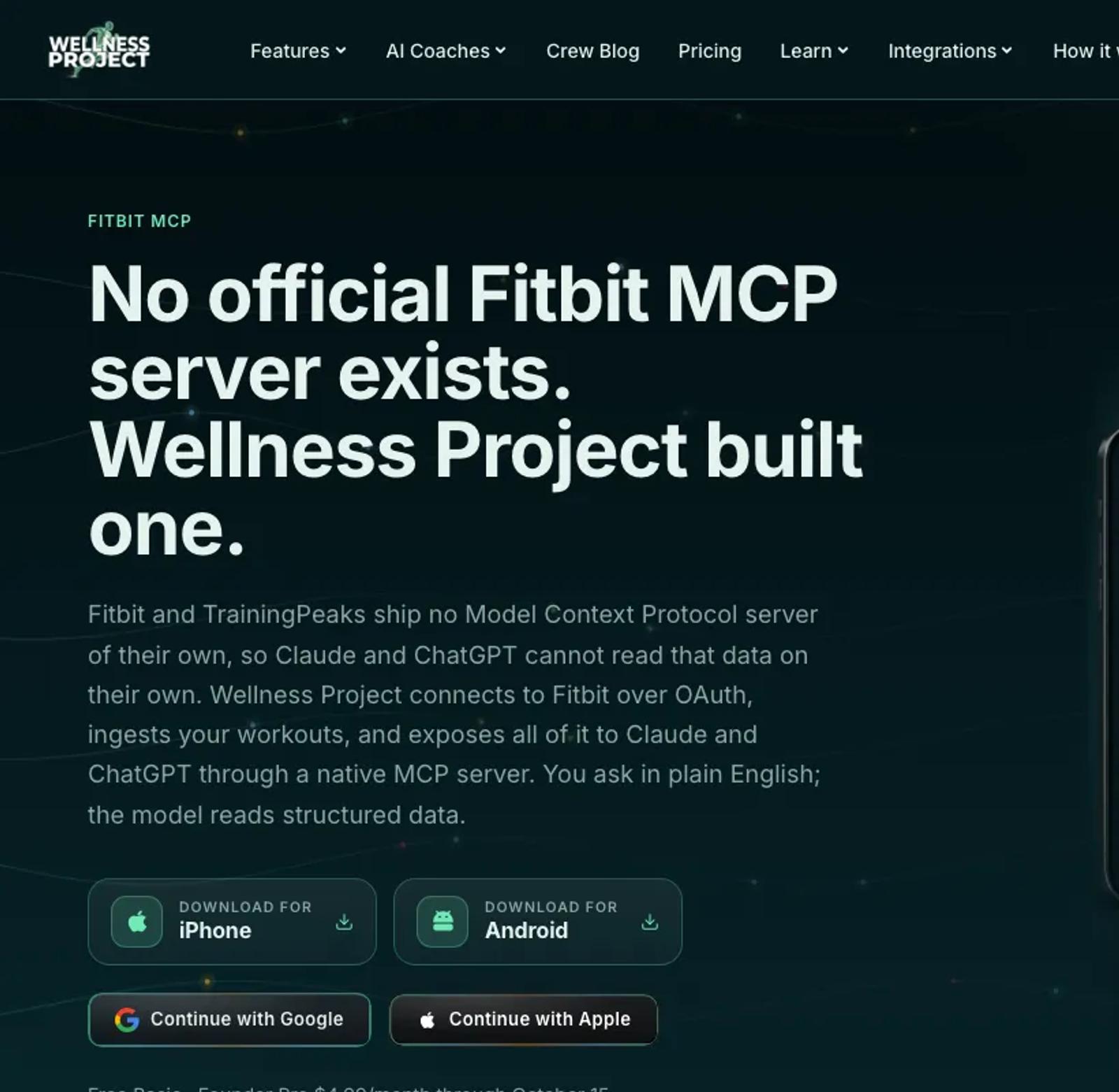
Wellness Project is a hosted coaching app with its own MCP server. It connects Fitbit through the Google Health API, so you sign in with Google and your phone plays no part. Its page says it syncs about every hour, and the vendor lists 73 tools, some of which write to Wellness Project.
The free plan allows 3 analysis chats a day, with the app and your AI app counted together. Adding it in ChatGPT takes a paid plan such as Plus or Pro, because custom connectors there need developer mode.
Setup: create an account, connect Fitbit through Google, then add its MCP address to your AI app and sign in.
Price: a free Basic plan. Pro is $9.99 a month or $99.99 a year, with an introductory $4.99 a month or $39.99 a year until October 15 (pricing).
Best for: people who want Fitbit in their AI app without a phone app, and a coaching app alongside.
3. Fulcra Context
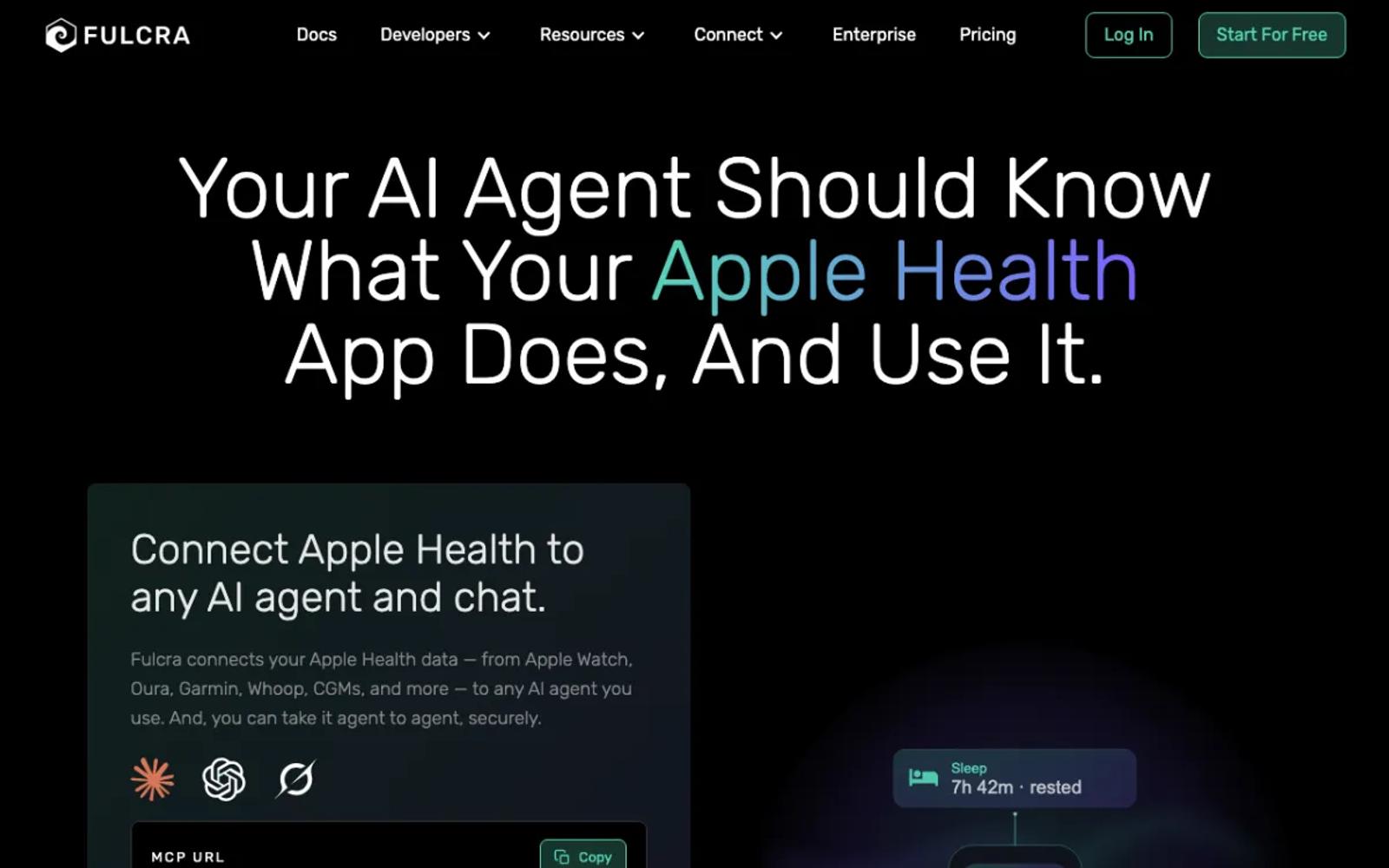
Fulcra Context is a personal data platform with a hosted MCP server. Its iPhone app reads Apple Health, so Fitbit data arrives once you turn on the Google Health share to Apple Health. Fulcra's pages do not mention Fitbit; the route works because Fulcra reads whatever Apple Health holds.
It is iPhone only (iOS 17 or later), and through this route it gets no HRV from Fitbit.
Setup: turn on the Apple Health share in the Google Health app, install Context, sign up, then add Fulcra's server to your AI app.
Price: Personal is free. Pro is $14.99 a month or $149.99 a year (pricing).
Best for: iPhone users who want a broader personal data store, not only health.
4. gorban-dev/google-health-mcp
A local server with a setup wizard: 20 tools, 7 of which write food, water, and weight logs, down to logging a meal from a photo. MIT licensed.
Setup: involved, on your own computer. Run its setup command in a terminal, and the wizard takes you through your own Google Cloud project and OAuth client, including the step that stops the 7-day cutoff. Desktop apps only.
Price: free and open source.
Best for: people at home in a terminal who want the gentlest self-run setup.
5. partymola/google-health-mcp
19 tools with a local SQLite cache, trend tools, and ECG readings, under GPL-3.0. It needs Python 3.13, and its guide to the Google Cloud steps is the clearest of the self-run options.
Setup: involved. Seven steps in the Google Cloud console, then one command to add it to Claude Code, which its docs target. Desktop apps only.
Price: free and open source.
Best for: developers who use Claude Code and want trends and a local cache.
6. davidmosiah/google-health-mcp
The most-starred server on the new API, with 60 stars, an MIT license, a beta label, and 26 tools that include setup and diagnostic helpers.
Setup: involved. Set up a Google Cloud OAuth client with the redirect address from its README, then run its setup, auth, and doctor commands. The README does not mention the 7-day cutoff, so publish your Google app before you sign in. Desktop apps only.
Price: free and open source.
Best for: developers who want the most-used option and its diagnostic tools.
7. akshaygoyal/google-health-mcp
A server you deploy yourself on Cloudflare Workers: 28 read-only tools for 38 data types, MIT licensed. Because it runs on the web, it works in claude.ai and on your phone, which the local servers cannot do.
Setup: the most of the servers here. You need a Google Cloud OAuth client, a Cloudflare account, Cloudflare's wrangler tool for storage and secrets, a token script, and a deploy. Then you paste a secret URL into your AI app.
Price: free, within Cloudflare's free tier.
Best for: developers who want a server they own that also works on their phone.
8. Open Wearables
An open-source platform that you run on your own server, with 2,558 stars and an MIT license. Since version 0.9.0 it has separate Google Health and Health Connect providers, and it includes an MCP server with 6 tools. It covers several other wearables too.
Setup: the most work on this list. You run a Docker stack with a database, set up a Google Cloud OAuth client and its keys, create an API key, and set up the MCP server. Desktop apps only.
Price: free software. You pay for the server.
Best for: developers who want several sources on hardware they control.
| Tool | Setup | Fitbit route | Price |
|---|---|---|---|
| freddy | Phone app; web, desktop, and phone | Phone share (Health Connect or Apple Health) | Free tier; $49/year |
| Wellness Project | None; web, desktop, and phone | Google Health API | Free (3 chats a day); Pro $9.99/mo |
| Fulcra Context | iPhone app; web, desktop, and phone | Phone share (Apple Health) | Free; Pro $14.99/mo |
| gorban-dev | Terminal and Google Cloud project; desktop only | Google Health API, your own project | Free |
| partymola | Terminal and Google Cloud project; desktop only | Google Health API, your own project | Free |
| davidmosiah | Terminal and Google Cloud project; desktop only | Google Health API, your own project | Free |
| akshaygoyal | Cloudflare deploy and Google Cloud project; web, desktop, and phone | Google Health API, your own project | Free (Cloudflare free tier) |
| Open Wearables | Your own server and Google Cloud project; desktop only | Google Health API or Health Connect | Free; you pay for hosting |
How to choose
For most people, the answer is freddy: no Google Cloud project, nothing to keep running, and it works in any AI app that speaks MCP, on your phone too. The exceptions:
- You want Fitbit in your AI app without a phone app: Wellness Project.
- You want a broad personal data store on your iPhone: Fulcra Context.
- You want to run it yourself: gorban-dev/google-health-mcp for the gentlest setup, or akshaygoyal/google-health-mcp if it must work on your phone.
- You want several sources on hardware you control: Open Wearables.
Whatever you pick, skip any Fitbit MCP server that asks for a dev.fitbit.com app. It is built on the API that Google is turning off.
Prices and details verified in September 2026. This space moves fast, so check each vendor's site for current details before you commit. For other wearables, see our roundup of wearable MCP servers.